Step into child health with Paediatrician, a CPD-accredited learning route for aspiring child healthcare professionals, paediatric support staff, and learners exploring how to become a paediatrician. Aimed at those who want to become confident in paediatric care, this programme builds essential knowledge in neonatology, nutrition, neurology, and ethics—turning compassion for children into credible career-focused progression and purpose today online.
4.7
(2 Reviews)
25 Students
Exclusive Deal! 94% Off, Today Only!
Sale Ends In
CPD Point
Do you feel drawn to working with babies, children, and young people—but need a credible starting point before deciding whether the pediatrician training path is right for you? That is exactly why this Paediatrician Course matters.Â
Child health services face real workforce pressure: RCPCH reported rota gaps above 20% across paediatric services in England, Scotland, and Northern Ireland in 2024, while the College’s 2025 workforce briefing said post-pandemic demand for child health services has increased at an unprecedented rate. At the same time, interest in the specialty is high: 2,780 applications competed for 476 UK ST1 paediatrics posts in 2025–26, a competition ratio of 5.63.Â
This CPD-accredited paediatrics course helps you build essential child-health knowledge before longer professional study or alongside care-based work. You will cover paediatric nutrition and nutritional disorders, neonatology, gastroenterology, haematology, neurology, immunology and allergy, oncology, and paediatrics, ethics, and the law. It offers focused insight before committing to longer, regulated medical or allied-health training pathways later.Â
Enrol now and build child-health confidence with a qualification that supports progression.
Build essential child-health knowledge from foundations to specialist topics. You will understand paediatric nutrition, neonatology, gastroenterology, haematology, neurology, immunology, oncology, and ethics while developing stronger clinical vocabulary, confidence, and career awareness for child-focused healthcare pathways and progression opportunities in practice.
This Paediatrician course online UK is designed to help you build essential, career-focused knowledge for child health awareness, paediatric support, developmental understanding, and healthcare progression roles, giving you the confidence and subject understanding employers and child-focused organisations increasingly value.
Whether you want foundational child-health knowledge, career-change direction, or preparation before longer medical or care training, this programme suits ambitious learners. It supports aspiring paediatric professionals, support workers, caregivers, and health learners seeking flexible, structured online study with CPD value.
There are no specific prerequisites to enrol in this Paediatrician – CPD Accredited Course. Anyone and everyone can take this course.
The Paediatrician – CPD Accredited Course is fully accessible from any internet-enabled smart device. So, you can study from the comfort of your home!
All you need is a passion for learning, literacy, and to be over the age of 16.
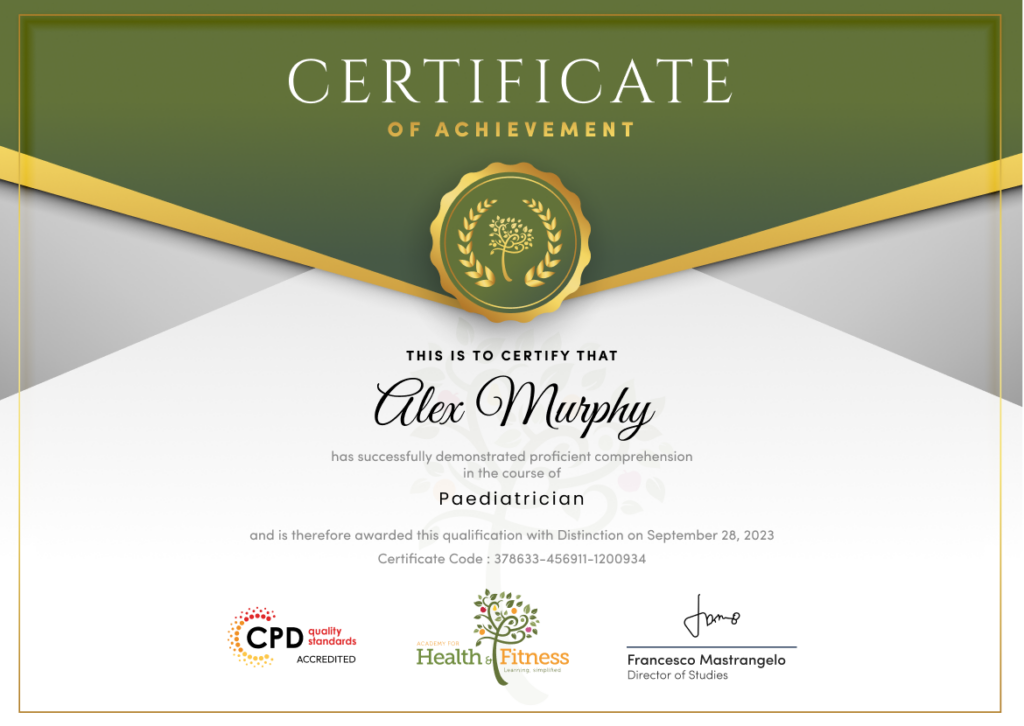
After successfully completing the Paediatrician course, you will qualify for a CPD Certificate as proof of your continued professional development and achievement. This certificate can enhance your professional profile and showcase your commitment to building relevant skills and knowledge. You can receive your digital certificate for only ÂŁ10, or request a printed hard copy sent by post for just ÂŁ29 or both for ÂŁ39.
After successfully completing the Paediatrician course, learners will be able to order a QLS Endorsed Certificate as proof of their new achievement. The Level QLS Endorsed certificate can be ordered and get delivered to your home by post for £119 only. There is an additional £10 postage charge for international students.
For assessing your learning, you have to complete an automated MCQ exam. It is required for the students to score at least 60% to pass the exam and fulfil the Quality Licence Scheme-endorsed certificate criteria. Learners can apply for the certificate after they clear the exam.
There are assignment questions provided at the end of the course. You are suggested to complete the questions to enrich your understanding of the course. You can complete this according to your preferred time. The expert tutor will provide feedback on your performance after assessing your assignment.
Child-health knowledge can strengthen progression into healthcare, therapy, support, and family-facing roles. Some positions require professional registration or further study. Below are realistic UK pathways this knowledge can support or complement when combined with recognised clinical, care, or allied-health qualifications.
Diagnose, treat, and monitor illnesses affecting babies, children, and young people across clinics, wards, and emergency settings. You would assess development, communicate with families, coordinate referrals, and lead evidence-based care decisions. This role sits at the heart of child health and requires a full regulated medical training pathway.
Salary range: £40,000 – £145,000
Work at a senior clinical level within child health services, supporting diagnosis, treatment planning, ward care, outpatient services, and multidisciplinary teamwork. This pathway suits qualified doctors building specialist experience outside the consultant track or progressing within SAS roles. Strong paediatric knowledge, clinical judgement, and communication remain central to success.
Salary range: £61,542 – £99,216
Support infants, children, and adolescents with acute or long-term health conditions in hospitals or community settings. You would monitor symptoms, administer treatment, reassure families, and work closely with paediatricians and multidisciplinary teams. Strong paediatric knowledge helps you provide safer, more compassionate care and communicate confidently with children.
Salary range: ÂŁ31,049 – ÂŁ46,580+Â
Care for premature babies and newborns needing extra monitoring, treatment, or intensive support. You would observe vital signs, support feeding, work with anxious families, and respond calmly in specialist neonatal environments. Knowledge of neonatology, nutrition, and developmental care makes this pathway especially relevant to child-focused healthcare learners.
Salary range: £31,049 – £54,710+
Assist nurses and clinical teams with day-to-day child patient care, comfort, observations, hygiene, and emotional support. You may work on children’s wards, outpatient departments, or assessment units. A solid understanding of child development, communication, and family-centred care can help you perform your role with greater confidence and empathy.
Salary range: £24,465 – £26,598
Provide practical, emotional, and administrative support in child-health environments, helping services run smoothly while keeping young patients comfortable and families informed. This role can involve preparing equipment, supporting routines, and assisting clinical staff. Paediatric awareness, safeguarding knowledge, and confident communication are valuable strengths for this pathway.
Salary range: £24,465 – £30,162
Promote child health, wellbeing, safeguarding, and early intervention within education settings. You might support immunisation programmes, health education, emotional wellbeing, and referrals for additional care. A paediatric knowledge base helps you understand developmental needs, communicate with children and parents, and recognise signs that may need prompt professional attention.
Salary range: ÂŁ38,682 – ÂŁ54,710Â
Work with babies, young children, and families in the community, supporting development, nutrition, safeguarding, and early years wellbeing. You would build trusted relationships, deliver advice, and spot concerns early. A strong grounding in child health, neonatal topics, and family-centred practice supports confident progression toward this rewarding role.
Salary range: ÂŁ38,682 – ÂŁ54,710Â
Help deliver child-health research studies by coordinating visits, collecting data, supporting ethics processes, and communicating with families and clinicians. This role suits detail-focused learners who enjoy evidence-based practice. Understanding paediatric conditions, ethics, and clinical language can strengthen your suitability for research environments focused on children and young people.
Salary range: £27,485 – £46,580
Use therapeutic play to reduce anxiety, prepare children for procedures, and improve the patient experience in healthcare environments. You would support emotional wellbeing, encourage expression, and help children cope with treatment. Knowledge of child development, illness, and family-centred practice can make your support more purposeful and effective.
Salary range: £27,485 – £46,580
Lead teams within children’s services, oversee standards, coordinate staffing, and help deliver safe, compassionate care. This senior pathway usually grows from nursing or clinical experience. Strong subject knowledge in child health, communication, ethics, and multidisciplinary teamwork supports progression into leadership roles where decisions directly affect patient experience and care quality.
Salary range: £47,810 – £62,682
You need a GMC-recognised medical degree, which normally takes five years, then the two-year Foundation Programme, then paediatric specialty training, which RCPCH says is nominally seven years. UK paediatric trainees also sit the MRCPCH exams as part of training.
If you mean after school or college, the usual UK-style route is to qualify for entry to a medicine degree, complete medical school, finish the Foundation Programme, and then enter paediatric specialty training. It is a long medical pathway, not a short certificate route.
You need a GMC-recognised degree in medicine. The GMC says UK medical courses normally last five years, or four years for some graduate-entry programmes.
In the standard UK route, it is typically around 14 years from the start of medical school: about five years for the medical degree, two years in the Foundation Programme, and seven years of paediatric specialty training. Exact timelines can vary with individual progression.
The serious answer is simple: medicine degree first, then foundation training, then paediatric specialty training, plus MRCPCH exams during training. Anyone selling you the idea that a short online course alone makes you employable as a paediatrician is selling nonsense.
To practise in the UK, you need recognised medical training and progression through the formal postgraduate pathway. RCPCH states that paediatric training is a run-through programme, and MRCPCH exams are part of that process.
For flexible CPD-based online paediatrics study, providers often allow broad access because it is knowledge-based learning rather than medical licensure. But actual paediatrician training has strict academic, clinical, and regulatory entry requirements because it is a doctor-only pathway.
Online CPD learning is usually flexible and self-paced. Becoming a paediatrician is not. The regulated route involves medical school, the Foundation Programme, and years of specialty training, so do not confuse a short course with the real professional timeline.
Do not obsess over the cheapest price. Compare syllabus depth, tutor support, flexibility, certification, access length, and whether the content actually matches your goal—child-health knowledge, support-role progression, or preparation before longer regulated medical or allied-health training.
In systems such as India, postgraduate medical education regulations describe broad-specialty degree training as three years, while NBEMS states DNB broad-specialty training is generally three years after MBBS, or two years for certain post-diploma entry routes. Exact recognition depends on local regulator rules and country.
The term “residency” is country-specific. In the UK, the comparable paediatric specialty training pathway is nominally seven years after the Foundation Programme. In other countries, the structure and naming can differ, so always check the regulator for your target country.
Yes, if your goal is to build child-health knowledge, strengthen your CV, or test whether paediatric care genuinely fits you. No, if you think it replaces medical school or specialist training. It helps with knowledge and progression; it does not give licence to practise as a paediatrician.
| Module 01: Introduction to Paediatrician | |||
| Being with Anxiety | 00:03:00 | ||
| Module 02: Paediatric Nutrition and Nutritional Disorder | |||
| Paediatric Nutrition and Nutritional Disorders | 00:22:00 | ||
| Module 03: Neonatology | |||
| Neonatology | 00:38:00 | ||
| Module 04: Gastroenterology | |||
| Gastroenterology | 00:47:00 | ||
| Module 05: Haematology | |||
| Haematology | 00:31:00 | ||
| Module 06: Neurology | |||
| Neurology | 00:37:00 | ||
| Module 07: Immunology and Allergy | |||
| Immunology and Allergy | 00:32:00 | ||
| Module 08: Oncology | |||
| Oncology | 00:47:00 | ||
| Module 09: Paediatrics, ethics, and the law | |||
| Paediatrics, ethics, and the law | 00:21:00 | ||
| Assignment | |||
| Assignment – Paediatrician | 00:00:00 | ||
| Order Your Certificate | |||
| Order Your Certificate | 00:00:00 | ||
| Module 01: Introduction to Paediatrician | |||
| Being with Anxiety | 00:03:00 | ||
| Module 02: Paediatric Nutrition and Nutritional Disorder | |||
| Paediatric Nutrition and Nutritional Disorders | 00:22:00 | ||
| Module 03: Neonatology | |||
| Neonatology | 00:38:00 | ||
| Module 04: Gastroenterology | |||
| Gastroenterology | 00:47:00 | ||
| Module 05: Haematology | |||
| Haematology | 00:31:00 | ||
| Module 06: Neurology | |||
| Neurology | 00:37:00 | ||
| Module 07: Immunology and Allergy | |||
| Immunology and Allergy | 00:32:00 | ||
| Module 08: Oncology | |||
| Oncology | 00:47:00 | ||
| Module 09: Paediatrics, ethics, and the law | |||
| Paediatrics, ethics, and the law | 00:21:00 | ||
| Assignment | |||
| Assignment – Paediatrician | 00:00:00 | ||
| Order Your Certificate | |||
| Order Your Certificate | 00:00:00 | ||