Master emotional resilience with Dialectical Behaviour Therapy (DBT), a CPD-accredited online programme for aspiring therapists, counsellors, mental health support workers, and wellbeing practitioners. Aimed at those who want to become calm, skilled, and credible helpers, this essential training shows how DBT transforms crisis into structure, emotion into action, and compassion into a career advantage in modern mental health support roles.
4.5
(6 Reviews)
51 Students
Exclusive Deal! 94% Off, Today Only!
Sale Ends In
CPD Point
Do you keep seeing clients, colleagues, or loved ones overwhelmed by emotion, impulsive reactions, self-defeating patterns, or relationship chaos—and wonder how to respond with a method that is structured, practical, and evidence-informed? That is exactly why dialectical behavior therapy matters to the learner: it teaches skills people can use immediately to manage distress, regulate emotion, improve communication, and build safer behavioural choices.
The demand is real. In England, 2.10 million people were in contact with mental health services at the end of May 2025. NHS Talking Therapies recorded 1.81 million referrals in 2024–25, with 670,419 completed courses of treatment and 50.5% of referrals moving to recovery. For learners exploring what is dialectical behavior therapy, how does dialectical behavior therapy work, who can dialectical behavior therapy help, and what is the difference between DBT and CBT, this training gives clear answers.Â
You will learn dialectical behavior therapy skills, dialectical behavior therapy techniques, DBT skills training, radical acceptance DBT, distress tolerance DBT skills, mindfulness, emotion regulation, interpersonal effectiveness, behavioural analysis, and how DBT is applied to borderline personality disorder, depression, anxiety, OCD, and eating disorders.
Enrol now and build essential, career-relevant confidence with an online DBT course designed for mental health learning.
Develop a clear, pragmatic understanding of DBT from core theory to applied skills. This learning journey helps you understand mindfulness, distress tolerance, emotion regulation, interpersonal effectiveness, treatment stages, behavioural analysis, so you can speak about the model with structure, confidence, credibility, and relevance in practice.
This dialectical behaviour therapy course online UK is designed to help you build essential, career-focused knowledge for emotional regulation, crisis response, therapeutic communication, and mental health support roles, giving you the confidence and subject understanding employers and care-focused organisations increasingly value.
Whether you want stronger therapeutic insight, essential mental health knowledge, or a foundation for helping roles, this programme suits beginners and developing professionals alike. It offers structured DBT understanding, flexible study, and skills that strengthen communication, emotional literacy, and confidence.
There are no specific prerequisites to enrol in this Dialectical Behaviour Therapy (DBT) – CPD Accredited Course. Anyone and everyone can take this course.
The Dialectical Behaviour Therapy (DBT) – CPD Accredited Course is fully accessible from any internet-enabled smart device. So, you can study from the comfort of your home!
All you need is a passion for learning, literacy, and to be over the age of 16.
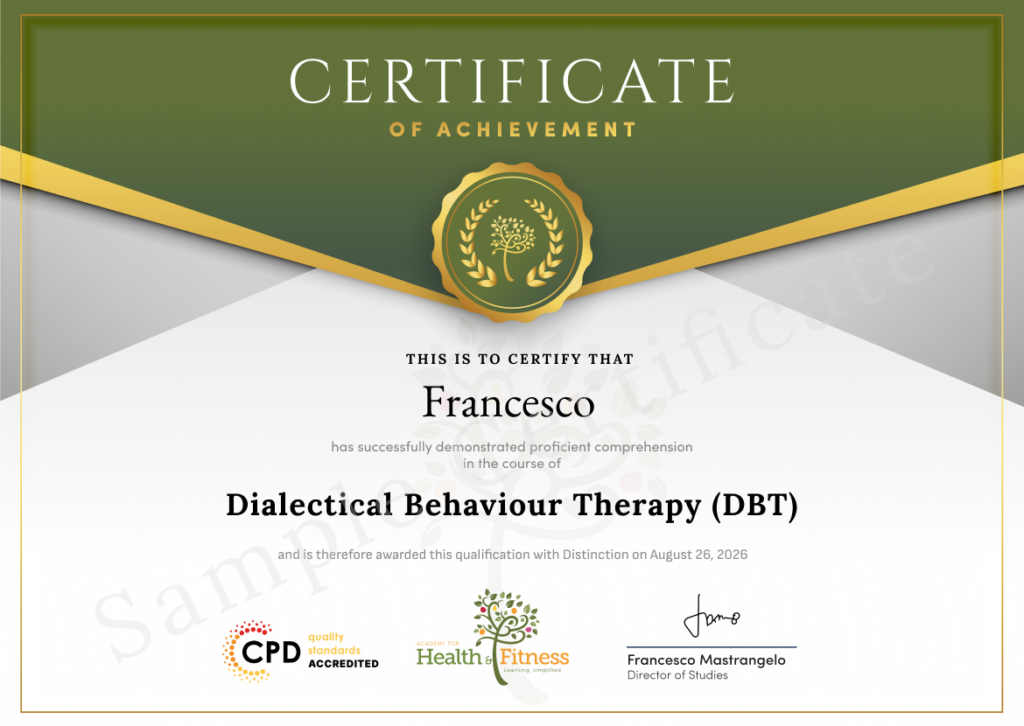
After successfully completing the Dialectical Behaviour Therapy (DBT) course, you will qualify for a CPD Certificate as proof of your continued professional development and achievement. This certificate can enhance your professional profile and showcase your commitment to building relevant skills and knowledge. You can receive your digital certificate for only £10, or request a printed hard copy sent by post for just £29 or both for £39.
After successfully completing the Dialectical Behaviour Therapy (DBT) course, learners will be able to order a QLS Endorsed Certificate as proof of their new achievement. The Level QLS Endorsed certificate can be ordered and get delivered to your home by post for £119 only. There is an additional £10 postage charge for international students.
For assessing your learning, you have to complete an automated MCQ exam. It is required for the students to score at least 60% to pass the exam and fulfil the Quality Licence Scheme-endorsed certificate criteria. Learners can apply for the certificate after they clear the exam.
There are assignment questions provided at the end of the course. You are suggested to complete the questions to enrich your understanding of the course. You can complete this according to your preferred time. The expert tutor will provide feedback on your performance after assessing your assignment.
DBT knowledge can support progression into mental health, therapy, wellbeing, support, and care-related roles. It does not replace professional licensing, but it strengthens subject understanding, communication, and client awareness. That matters in services facing sustained mental-health demand, growing therapy referrals, and continued need for skilled, emotionally informed staff across services.Â
Salary range: £25,000 – £48,000.
Salary range: £28,000 – £39,000.
Salary range: £40,000 – £57,000.Â
Salary range: £32,000 – £48,000.
Salary range: £32,000 – £48,000.Â
Salary range: £49,000 – £65,000.Â
Salary range: £20,000 – £25,000.Â
Salary range: £31,000 – £53,000.
Dialectical behaviour therapy, or DBT, is a talking therapy based on CBT but specially adapted for people who feel emotions very intensely. Its aim is to help people understand and accept difficult feelings, learn practical coping skills, and make positive behavioural changes.
DBT works by combining validation with change. NHS sources explain that it targets harmful behaviours, teaches specific coping skills, and focuses on mindfulness, interpersonal effectiveness, emotion regulation, and distress tolerance.
DBT was originally developed for borderline personality disorder. Mind notes that it may also help with self-harm, suicide attempts, depression, drug and alcohol problems, and eating problems, although suitability depends on the individual and service available.
The four core DBT skill areas are mindfulness, interpersonal effectiveness, emotion regulation, and distress tolerance. These are the central practical skills people learn and apply in daily life.
DBT is commonly taught through four modules: mindfulness, distress tolerance, emotion regulation, and interpersonal effectiveness. In practice, these modules help people become more aware, more stable, and less impulsive under pressure.
NHS guidance says DBT has proved particularly effective for women with BPD who have a history of self-harming and suicidal behaviour, and notes that NICE recommends it as a first treatment to try for that group.
Mind explains that CBT focuses on changing unhelpful ways of thinking and behaving. DBT does that too, but it adds a stronger focus on acceptance, emotional intensity, and balancing change with validation.
There is no instant timeline. NHS guidance says treatment for BPD may last a year or longer, while NICE’s public glossary says DBT usually takes place over one year with weekly one-to-one and group meetings.
Yes. NHS material describes emotion regulation as learning how to understand and label emotions, manage intense emotional states, and build conditions that support more positive emotions over time.
They can be. Mind says DBT self-help materials may include diary cards, exercises, and behavioural analysis sheets, and these can be used alongside formal training or after it ends to keep skills active.
It is worth it when the goal is CPD, structured theory, stronger therapeutic language, and practical skills awareness. It is not a shortcut to protected professional titles, statutory registration, or independent clinical practice.
DBT knowledge is especially relevant in counselling, psychotherapy, psychological wellbeing, mental health nursing, social work, occupational therapy, care work, and child-focused therapeutic roles. The hard truth: role entry still depends on each profession’s formal training, registration, and supervised practice pathway.
| Introduction | |||
| About the Instructor | FREE | 00:02:00 | |
| About the Course | FREE | 00:06:00 | |
| What is Counselling & Psychotherapy | |||
| Definition of Counselling | FREE | 00:07:00 | |
| Counselling & Psychotherapy | 00:07:00 | ||
| Approaches in Counselling & Psychotherapy | 00:12:00 | ||
| About Dialectical Behaviour Therapy (DBT) | |||
| What is DBT? | 00:05:00 | ||
| What is ‘dialectical’? | 00:06:00 | ||
| History & Philosophy of DBT | 00:06:00 | ||
| DBT Strategies & 'Life Skills' | |||
| What is ‘Mindfulness’ | 00:08:00 | ||
| What is ‘Distress Tolerance’ | 00:10:00 | ||
| What is ‘Emotion regulation’ | 00:11:00 | ||
| What is ‘Interpersonal Effectiveness’ | 00:06:00 | ||
| Treatment by DBT | |||
| Multistage approach of DBT | 00:06:00 | ||
| The Stages of Treatment in DBT | 00:11:00 | ||
| Prioritising Treatments Targets | 00:05:00 | ||
| How to set up ‘learning environment’ for the client | 00:07:00 | ||
| How to conduct ‘Behavioural Analysis’ | 00:11:00 | ||
| DBT for Psychological Disorders | |||
| Uses of DBT | 00:03:00 | ||
| DBT in the treatment of Borderline Personality Disorder | 00:07:00 | ||
| DBT in the treatment of Depression | 00:09:00 | ||
| DBT for treatment of Anxiety & OCD | 00:08:00 | ||
| DBT for treatment of ‘Eating Disorders’ | 00:08:00 | ||
| Effectiveness of DBT | |||
| How effective is DBT? | 00:07:00 | ||
| Criticism and Limitations of DBT | 00:05:00 | ||
| Thank You and Good Bye! | 00:04:00 | ||
| Order Your Certificate | |||
| Order your Certificate | 00:00:00 | ||
| Introduction | |||
| About the Instructor | FREE | 00:02:00 | |
| About the Course | FREE | 00:06:00 | |
| What is Counselling & Psychotherapy | |||
| Definition of Counselling | FREE | 00:07:00 | |
| Counselling & Psychotherapy | 00:07:00 | ||
| Approaches in Counselling & Psychotherapy | 00:12:00 | ||
| About Dialectical Behaviour Therapy (DBT) | |||
| What is DBT? | 00:05:00 | ||
| What is ‘dialectical’? | 00:06:00 | ||
| History & Philosophy of DBT | 00:06:00 | ||
| DBT Strategies & 'Life Skills' | |||
| What is ‘Mindfulness’ | 00:08:00 | ||
| What is ‘Distress Tolerance’ | 00:10:00 | ||
| What is ‘Emotion regulation’ | 00:11:00 | ||
| What is ‘Interpersonal Effectiveness’ | 00:06:00 | ||
| Treatment by DBT | |||
| Multistage approach of DBT | 00:06:00 | ||
| The Stages of Treatment in DBT | 00:11:00 | ||
| Prioritising Treatments Targets | 00:05:00 | ||
| How to set up ‘learning environment’ for the client | 00:07:00 | ||
| How to conduct ‘Behavioural Analysis’ | 00:11:00 | ||
| DBT for Psychological Disorders | |||
| Uses of DBT | 00:03:00 | ||
| DBT in the treatment of Borderline Personality Disorder | 00:07:00 | ||
| DBT in the treatment of Depression | 00:09:00 | ||
| DBT for treatment of Anxiety & OCD | 00:08:00 | ||
| DBT for treatment of ‘Eating Disorders’ | 00:08:00 | ||
| Effectiveness of DBT | |||
| How effective is DBT? | 00:07:00 | ||
| Criticism and Limitations of DBT | 00:05:00 | ||
| Thank You and Good Bye! | 00:04:00 | ||
| Order Your Certificate | |||
| Order your Certificate | 00:00:00 | ||