Take a meaningful step into the world of mental health and wellbeing with the Level 3 Diploma in Cognitive Behavioural Therapy – QLS Endorsed. This flexible online CBT course helps you build understanding of anxiety, stress, emotional wellbeing, and core CBT principles, making it a valuable choice for learners seeking recognised training in a growing area of support.
Exclusive Deal! 94% Off, Today Only!
Sale Ends In
Level 3 Diploma in Cognitive Behavioural Therapy – QLS Endorsed is designed for learners who want to build stronger understanding of anxiety, stress, emotional wellbeing, and CBT-related ideas in a structured and flexible way. In England, 22.6% of people aged 16 to 64 were estimated to have a common mental health condition in 2023/24, showing how relevant mental health knowledge has become.
This online CBT course covers stress psychology, coping strategies, anxiety disorders, psychotherapy for anxiety, CBT for anxiety disorders, mindfulness-based therapy, medication approaches, and anxiety-reducing techniques. It gives learners a clearer understanding of how thoughts, emotions, behaviours, and support strategies connect in wellbeing-focused settings.
Whether you are searching for a CBT diploma course, online cognitive behavioural therapy course, anxiety and stress management course, or mental health awareness training, this programme offers a strong starting point. It can support progression towards UK roles such as Wellbeing Support Worker, Mental Health Support Assistant, Support Worker, or other counselling-adjacent support roles. The National Careers Service lists counsellor salaries at £25,000 to £48,000 a year, though specialist therapist roles usually require further formal training.
Enrol today to strengthen your CV, deepen your understanding of emotional wellbeing, and take a meaningful step towards personal and professional growth
The Level 3 Diploma in Cognitive Behavioural Therapy – QLS Endorsed introduces learners to key CBT concepts and how they relate to stress, anxiety, emotional wellbeing, and behaviour change.
This online cognitive behavioural therapy course helps you understand how thoughts, feelings, and behaviours influence one another. You will also explore how stress and anxiety affect wellbeing, how anxiety disorders may develop, and how CBT-based approaches can support healthier coping strategies.
The course also introduces mindfulness-based therapy, psychotherapy for anxiety, medication awareness, and anxiety-reducing techniques. It is ideal for learners interested in mental health, wellbeing, care, support work, counselling-adjacent study, or personal development.
This course supports knowledge-building and professional development. Specialist therapy roles usually require further formal training, supervised practice, and recognised professional pathways.
Our online CBT course builds understanding of stress, anxiety, mindfulness, coping methods, and emotional wellbeing through structured introductory learning.
By completing this course, you will be able to:
This Level 3 Diploma in Cognitive Behavioural Therapy – QLS Endorsed offers flexible mental health learning focused on anxiety, stress, wellbeing, and CBT concepts.
Mental health awareness is increasingly important across workplaces, care settings, education, community support, and everyday life. This Level 3 Diploma in Cognitive Behavioural Therapy helps you build a clearer understanding of anxiety, stress, thought patterns, and emotional wellbeing.
As a flexible online CBT course, it gives learners a structured introduction to CBT-related ideas without needing previous experience. It can support personal development, wellbeing-focused learning, or progression towards further study in counselling, psychology, support work, or mental health awareness.
Completing this Level 3 Diploma in Cognitive Behavioural Therapy can support progression towards mental health, wellbeing, support, and care-related roles. Specialist therapy roles usually require further formal training, supervised practice, or professional registration routes.
Potential career paths include:
You can enrol in the Level 3 Diploma in Cognitive Behavioural Therapy – QLS Endorsed with no formal qualifications or previous experience required. This course is suitable for beginners as well as learners who want to build knowledge in stress, anxiety, emotional wellbeing, and CBT-related concepts.
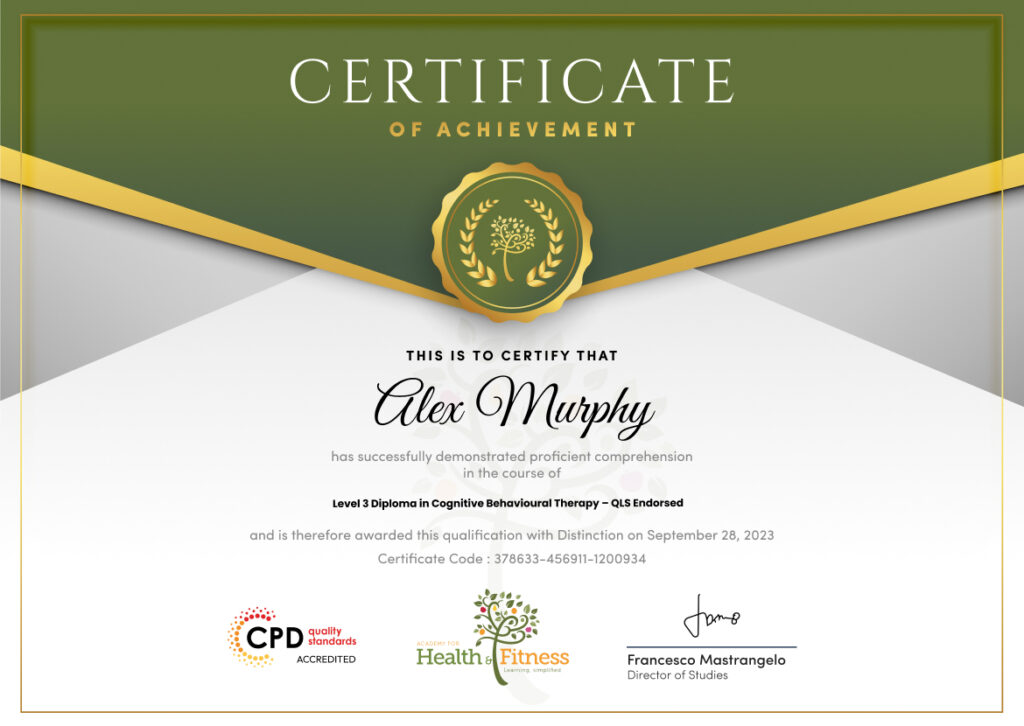
After successfully completing the Level 3 Diploma in Cognitive Behavioural Therapy – QLS Endorsed course, you will qualify for a CPD Certificate as proof of your continued professional development and achievement. This certificate can enhance your professional profile and showcase your commitment to building relevant skills and knowledge. You can receive your digital certificate for only £10, or request a printed hard copy sent by post for just £29 or both for £39.
After successfully completing the course, learners will be able to order a QLS Endorsed Certificate as proof of their new achievement. The Level QLS Endorsed certificate can be ordered and get delivered to your home by post for £89 only. There is an additional £10 postage charge for international students.
For assessing your learning, you have to complete an automated MCQ exam. It is required for the students to score at least 60% to pass the exam and fulfil the Quality Licence Scheme-endorsed certificate criteria. Learners can apply for the certificate after they clear the exam.
There are assignment questions provided at the end of the course. You are suggested to complete the questions to enrich your understanding of the course. You can complete this according to your preferred time. The expert tutor will provide feedback on your performance after assessing your assignment.
Completing this Level 3 Diploma in Cognitive Behavioural Therapy can support progression towards mental health, wellbeing, support, and care-related roles. Specialist therapy roles usually require further formal training, supervised practice, or professional registration routes.
Potential career paths include:
Physiotherapy Assistant – CPD Certified is an online healthcare-support course covering physiotherapy foundations, rehabilitation support, injury prevention, musculoskeletal topics, and therapy methods. It is aimed at learners who want broader therapy-support knowledge rather than professional physiotherapist registration.
Yes. This is a fully online course that can be studied using a computer, tablet, or smartphone. That makes it suitable for flexible study around work, family life, or other commitments while building rehabilitation-support knowledge from home.
No. The course is presented as accessible to beginners and learners exploring support-level healthcare knowledge. It is suitable for people who want to understand physiotherapy support, rehabilitation, and movement-focused care without needing previous formal experience.
The course covers physiotherapy foundations, skeletal muscle structure, the neuromuscular system, injury prevention, sports physiotherapy, osteoporosis, back pain, hydrotherapy, musculoskeletal physiotherapy, TENS machines, therapeutic ultrasound, and broader physiotherapy-support knowledge.
Yes. The course is presented as CPD Certified, which makes it useful for professional development, broader healthcare learning, and CV building. Successful learners can obtain a CPD-accredited certificate after completing the required assessment.
No. This course does not entitle learners to join the HCPC register or become recognised physiotherapists. It is best understood as a support-level or professional-development course, not a professional registration or licence route.
Assessment is through an automated multiple-choice question session after the learning stages are completed. Results are provided immediately after completion, making the assessment process straightforward and quick for learners studying online.Faq Answer 3
Yes. After successfully completing the assessment, learners can qualify for a CPD-accredited certificate. The course page lists certificate prices as £10 for digital, £29 for UK hard copy, and £39 for international hard copy.
Yes. Because the course is designed as support-level learning and does not position itself as a registration route, it can work well for beginners who want an introduction to physiotherapy support, rehabilitation knowledge, and movement-focused care topics.
This course can support knowledge-building for roles such as Physiotherapy Assistant, Physiotherapy Support Worker, Rehabilitation Assistant, Occupational Therapy Support Worker, or Healthcare Assistant. Specific job entry still depends on employer expectations, experience, and sometimes additional workplace training.
Yes. The curriculum includes movement support, injury prevention, musculoskeletal topics, hydrotherapy, TENS, and therapy methods, so it can strengthen your understanding of rehabilitation-adjacent care and support pathways in the UK.
Yes. Learners already working in care, support, or healthcare environments may find it useful for strengthening knowledge of rehabilitation, mobility support, and therapy-related concepts that can add value in patient-facing support roles.
Yes. The course can be accessed from a computer, tablet, or smartphone. That makes it a flexible option for people who want to fit study around work, family, travel, or other everyday responsibilities.
It can be a useful starting point for learners who want broader rehabilitation and movement-support knowledge without entering a full professional registration route. It is most valuable as a confidence-building and CV-supporting course for therapy-adjacent pathways.
| Cognitive Behavioural Therapy Course | |||
| Psychology of Stress | |||
| What is ‘Stress’ ? | 00:09:00 | ||
| How does ‘stress’ affect us? | 00:09:00 | ||
| Why do we experience ‘stress’ differently? | 00:10:00 | ||
| ‘Good stress’ (Eustress) Vs ‘Bad stress’ (Distress) | 00:09:00 | ||
| ‘Stress’ and ‘Burnout’ | 00:09:00 | ||
| Individual experiences of 'stress' | |||
| Coping with stress as an individual | 00:09:00 | ||
| Low ability (inability) to cope with stressors | 00:07:00 | ||
| What do people use to cope with stress? | 00:10:00 | ||
| ‘Addictions’ and Coping with ‘Stress’ | 00:09:00 | ||
| Stress Management | |||
| ‘Breathing’ in Stress Management | 00:08:00 | ||
| Stress-Reducing Techniques | 00:10:00 | ||
| Medication Treatments (Pharmacology) – Part 1 | 00:06:00 | ||
| Medication Treatments (Pharmacology) – Part 2 | 00:04:00 | ||
| Nutrition and ‘Stress’ – Part 1 | 00:04:00 | ||
| Nutrition and ‘Stress’ – Part 2 | 00:06:00 | ||
| Psychology of 'Anxiety' | |||
| What do we call ‘anxiety’? | 00:06:00 | ||
| What is the difference between ‘stress’ and ‘anxiety’? | 00:07:00 | ||
| When does ‘anxiety’ become an ‘anxiety disorder’? | 00:05:00 | ||
| Anxiety Disorders | |||
| Generalised Anxiety Disorder (GAD) | 00:08:00 | ||
| Social Anxiety Disorder (Social Phobia) | 00:08:00 | ||
| Panic Disorder | 00:07:00 | ||
| ‘Addictions’ and Anxiety Disorders | 00:10:00 | ||
| Coping with Anxiety | |||
| Psychotherapy for Anxiety Disorders | 00:08:00 | ||
| Cognitive Behavioural Therapy (CBT) for Anxiety Disorders | 00:09:00 | ||
| Mindfulness & Mindfulness Based Therapy (MBT) | 00:11:00 | ||
| Medial Treatments (Pharmacology) | 00:05:00 | ||
| Anxiety-Reducing Techniques | 00:10:00 | ||
| Final Words | |||
| Good Bye and Thank You! | 00:02:00 | ||
| Order Your Certificate | |||
| Claim Your Certificates | 00:00:00 | ||
| Cognitive Behavioural Therapy Course | |||
| Psychology of Stress | |||
| What is ‘Stress’ ? | 00:09:00 | ||
| How does ‘stress’ affect us? | 00:09:00 | ||
| Why do we experience ‘stress’ differently? | 00:10:00 | ||
| ‘Good stress’ (Eustress) Vs ‘Bad stress’ (Distress) | 00:09:00 | ||
| ‘Stress’ and ‘Burnout’ | 00:09:00 | ||
| Individual experiences of 'stress' | |||
| Coping with stress as an individual | 00:09:00 | ||
| Low ability (inability) to cope with stressors | 00:07:00 | ||
| What do people use to cope with stress? | 00:10:00 | ||
| ‘Addictions’ and Coping with ‘Stress’ | 00:09:00 | ||
| Stress Management | |||
| ‘Breathing’ in Stress Management | 00:08:00 | ||
| Stress-Reducing Techniques | 00:10:00 | ||
| Medication Treatments (Pharmacology) – Part 1 | 00:06:00 | ||
| Medication Treatments (Pharmacology) – Part 2 | 00:04:00 | ||
| Nutrition and ‘Stress’ – Part 1 | 00:04:00 | ||
| Nutrition and ‘Stress’ – Part 2 | 00:06:00 | ||
| Psychology of 'Anxiety' | |||
| What do we call ‘anxiety’? | 00:06:00 | ||
| What is the difference between ‘stress’ and ‘anxiety’? | 00:07:00 | ||
| When does ‘anxiety’ become an ‘anxiety disorder’? | 00:05:00 | ||
| Anxiety Disorders | |||
| Generalised Anxiety Disorder (GAD) | 00:08:00 | ||
| Social Anxiety Disorder (Social Phobia) | 00:08:00 | ||
| Panic Disorder | 00:07:00 | ||
| ‘Addictions’ and Anxiety Disorders | 00:10:00 | ||
| Coping with Anxiety | |||
| Psychotherapy for Anxiety Disorders | 00:08:00 | ||
| Cognitive Behavioural Therapy (CBT) for Anxiety Disorders | 00:09:00 | ||
| Mindfulness & Mindfulness Based Therapy (MBT) | 00:11:00 | ||
| Medial Treatments (Pharmacology) | 00:05:00 | ||
| Anxiety-Reducing Techniques | 00:10:00 | ||
| Final Words | |||
| Good Bye and Thank You! | 00:02:00 | ||
| Order Your Certificate | |||
| Claim Your Certificates | 00:00:00 | ||